A Planet in a Different Light
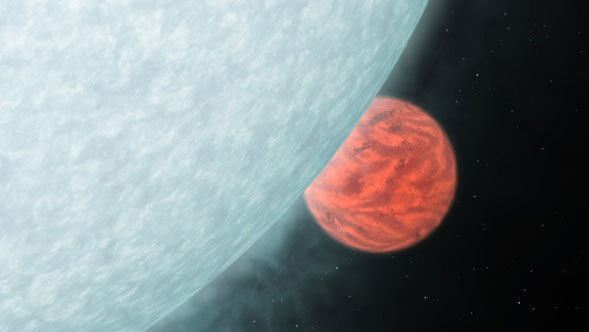
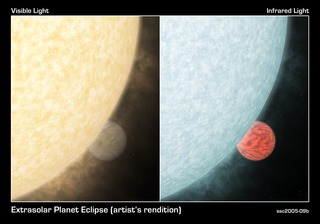
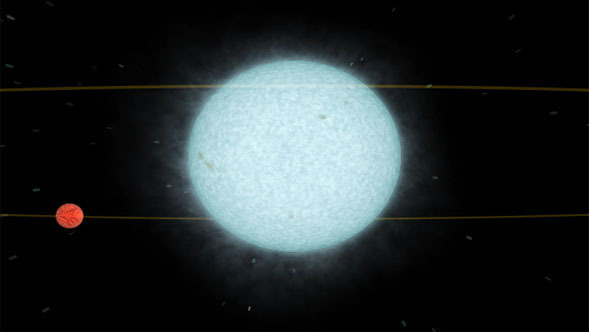
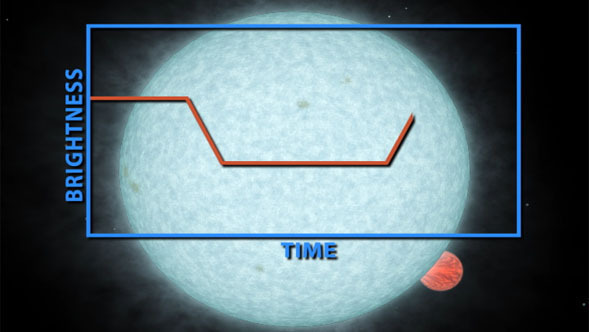
This artist's animation shows first what a fiery hot star and its close-knit planetary companion might look like close up in visible light, then switches to infrared views. In visible light, a star shines brilliantly, overwhelming the little light that is reflected by its planet. In infrared, a star is less blinding, and its planet perks up with a fiery glow.
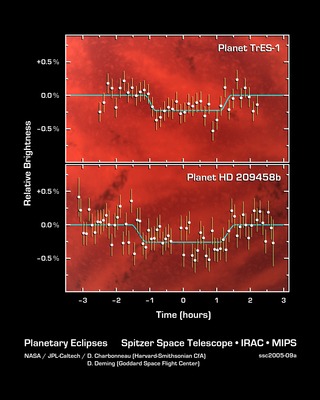
Astronomers using NASA's Spitzer Space Telescope took advantage of this fact to directly capture the infrared light of two previously detected planets orbiting stars outside our solar system. Their findings revealed the temperatures and orbits of the planets. Upcoming Spitzer observations using a variety of infrared wavelengths may provide more information about the planets' winds and atmospheric compositions.
In this animation, the colors represent real differences between the visible and infrared views of the system. The initial visible view shows what our eyes would see if we could witness the system close up. The hot star is yellow, because like our Sun, it is brightest in yellow wavelengths. The warm planet, on the other hand, is brightest in infrared light, which we can't see. Instead, we would see the glimmer of star light that the planet reflects.
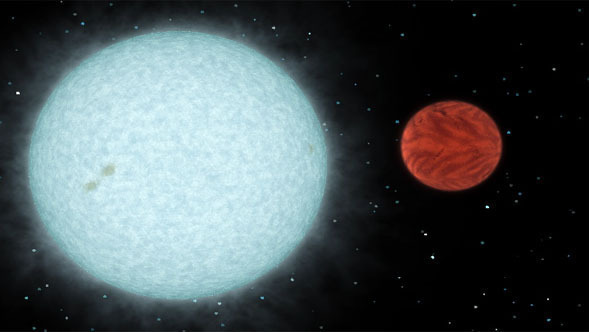
In the second half of the animation, the colors reflect what our eyes might see if we could retune them to the invisible, infrared portion of the light spectrum. The hot star is less bright in infrared light than in visible and appears fainter. The warm planet peaks in infrared light, so is shown brighter. Their hues represent relative differences in temperature. Because the star is hotter than the planet, and because hotter objects give off more blue light than red, the star is depicted in blue, and the planet, red.
The overall look of the planet is inspired by theoretical models of hot, gas giant planets. These "hot Jupiters" are similar to Jupiter in composition and mass, but are expected to look quite different at such high temperatures. The models are courtesy of Drs. Curtis Cooper and Adam Showman of the University of Arizona, Tucson.
Browse Videos in Science Animations
07.18.12 Flying Out to GJ 436 and its PlanetsStarting from Earth, we quickly zoom out of the solar system into our sun's local neighborhood, populated by the clos... |
05.08.12 Super Earth Reveals Itself to Spitzer (Narrated)NASA's Spitzer Space Telescope has, for the first time, captured the light emanating from a distant super Earth, a pl... |
05.08.12 Super Earth Reveals Itself to SpitzerNASA's Spitzer Space Telescope has, for the first time, captured the light emanating from a distant super Earth, a pl... |
10.19.10 Weird Warm Spot on ExoplanetThis animation illustrates an unexpected warm spot on the surface of a gaseous exoplanet. NASA's Spitzer Space Telesc... |
10.19.10 Weird Warm Spot on Exoplanet (Narrated)This animation illustrates an unexpected warm spot on the surface of a gaseous exoplanet. NASA's Spitzer Space Telesc... |
|
10.06.09 Saturn Family TourThis video showcases the Saturnian system, beginning with the planet itself and panning out to its newest addition --... |
|
08.10.09 Planetary Demolition DerbyThis artist's animation shows a celestial body about the size of our moon slamming at great speed into a body the siz... |
06.04.09 Silicate Crystal Formation in the Disk of an Erupting StarThis artist's animation illustrates how silicate crystals like those found in comets can be created by an outburst fr... |
06.04.09 Tour of Planet with Extreme Temperature SwingsThis animation shows a computer simulation of the planet HD 80606b from an observer located at a point in space lying... |
07.15.08 Zooming in on Second-Brightest Star in Milky WayThis movie zooms in to reveal the "Peony nebula" star -- the new second-brightest star in the Milky Way, discovered i... |
05.05.08 Dissecting a Light EchoThis animation illustrates how a light echo works, and how an optical illusion of material moving outward is created.... |
05.05.08 Cauldron of LightIn this animation, a seething cauldron of light appears to bubble and ooze around the remains of a giant star that as... |
11.29.07 Pulling Back the Curtain of DustThis artist's animation begins by showing a dark and dusty corner of space where little visible light can escape. The... |
05.09.07 Blacker than BlackThis artist's animation illustrates the hottest planet yet observed in the universe. The scorching ball of gas, a "ho... |
05.09.07 Mapping Exotic WorldsThis animation shows the first-ever map of the surface of an exoplanet, or a planet beyond our solar system. The map,... |
05.09.07 How to Map a Very Faraway PlanetScientists using NASA's Spitzer Space Telescope were able to create the first-ever map of the surface of a planet bey... |
04.18.07 Highway to the Danger Zone"The further on the edge, the hotter the intensity," sings Kenny Loggins in "Danger Zone," a song made famous by the ... |
04.18.07 Infrared RoseThis movie begins by showing an optical image of the Rosette nebula, a turbulent star-forming region located 5,000 li... |
03.29.07 Two Suns Raise Family of Planetary BodiesThis artist's animation depicts a faraway solar system like our own -- except for one big difference. Planets and ast... |
02.21.07 Hot, Dry, and Cloudy (Artist Concept)This artist's concept animation shows a cloudy Jupiter-like planet that orbits very close to its fiery hot star. NASA... |
12.18.06 Stars Spring Up Out of the DarknessThis artist's animation illustrates the universe's early years, from its explosive formation to its dark ages to its ... |
11.07.06 Hubble-Spitzer OrionThis video cycles between the Hubble view, the Spitzer view, and the combined Hubble-Spitzer view of the Orion Nebula. |
11.07.06 Making a Great Observatories CompositeThis video shows how a Hubble image and a Spitzer image of the Orion Nebula were combined to create a new, multi-wave... |
10.30.06 Who Ya Gonna Call?NASA's Spitzer Space Telescope is a galactic ghost buster, spotting hidden massive stars and other monsters lurking i... |
10.26.06 Order Amidst Chaos of Star's ExplosionThis artist's animation shows the explosion of a massive star, the remains of which are named Cassiopeia A. NASA's Sp... |
10.12.06 Fire and Ice Planet (without data plot)This artist's animation shows a blistering world revolving around its nearby "sun." NASA's infrared Spitzer Space Tel... |
10.12.06 Fire and Ice PlanetThis artist's animation shows a blistering world revolving around its nearby "sun." NASA's infrared Spitzer Space Tel... |
08.14.06 Journey to OrionThis movie begins with a visible view of the famous Orion constellation. Superimposed on the area near Orion's sword ... |
07.24.06 Stars Can't Spin Out of ControlThis artist's animation demonstrates how a dusty planet-forming disk can slow down a whirling young star, essentially... |
06.05.06 Fade to RedThis animation shows the Andromeda galaxy, first as seen in visible light by the National Optical Astronomy Observato... |
04.05.06 Birth of 'Phoenix' Planets?This artist's animation depicts the explosive death of a massive star, followed by the creation of a disk made up of ... |
03.16.06 Cigar Galaxy up in SmokeThis movie compares a visible-light view of the "Cigar galaxy" to an infrared view from NASA's Spitzer Space Telescop... |
06.09.05 The Cry of Cassiopeia AThis animation begins with a stunning false-color picture of the supernova remnant Cassiopeia A. It is made up of ima... |
06.02.05 Space Eyes See Comet Tempel 1This artist's concept of Tempel 1 illustrates the comet's shape, reflectivity, rotation rate and surface temperature,... |
05.30.05 Pillars Behind the DustThe movie begins with a visible-light picture of the southern region of our Milky Way galaxy then slowly zooms into t... |
05.30.05 Carina in ContextThis animation starts with an image of a larger but lower resolution image of the Carina Nebula from the Midcourse Sp... |
05.04.05 A More Spectacular SombreroThis movie shifts from the well-known visible-light picture of Messier 104 taken by the Hubble Space Telescope to inf... |
04.20.05 Band of RubbleThis artist's animation illustrates a massive asteroid belt in orbit around a star the same age and size as our Sun. ... |


Page
1
of
2