Spitzer Discovers Hidden Ring
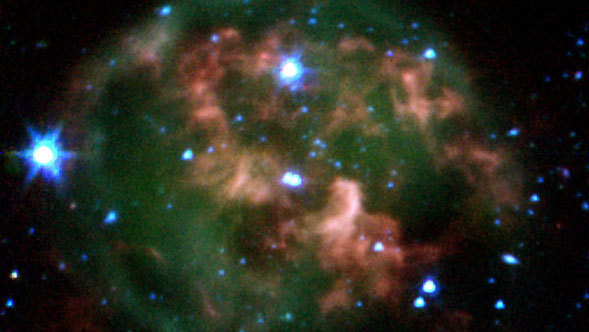
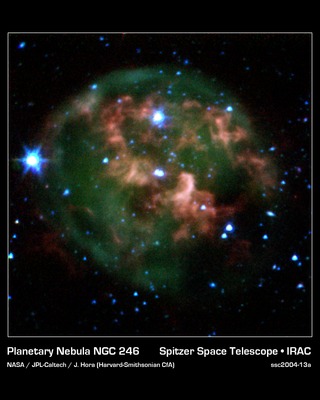
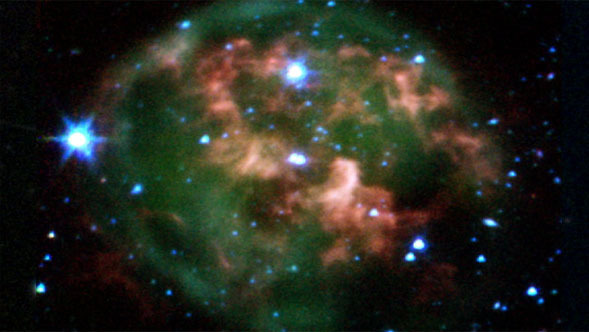
This animation transitions from a visible light image of the planetary nebula called NGC 246 to Spitzer's new infrared view. The movie highlights Spitzer's ability to see the invisible; as the movie dissolves to the Spitzer image, a giant ring (red) emerges. This clumpy ring consists of material that was expelled from the aging star at the center of the nebula.
Planetary nebulas are clouds of gas and dust that surround dying stars. When a star like our own Sun begins to run out of fuel, its core shrinks and heats up, boiling off the star's outer layers. Leftover material shoots outward, expanding in shells around the star. This ejected material is then bombarded with ultraviolet light from the central star's fiery surface, producing huge, glowing clouds -- planetary nebulas -- that look like giant jellyfish in space.
In the Spitzer image, the expelled gases appear green, and the ring of expelled material appears red. Astronomers believe the ring is likely made of hydrogen molecules that were ejected from the star in the form of atoms, then cooled to make hydrogen pairs. The new data will help explain how planetary nebulas take shape, and how they nourish future generations of stars.
The Spitzer image composite was taken on Dec. 6, 2003, by Spitzer's infrared array camera, and is composed of images obtained at four wavelengths: 3.6 microns (blue), 4.5 microns (green), 5.8 microns (orange) and 8 microns (red).
The visible light image is from the Advanced Observing Program of the National Optical Astronomy Observatory. Visible-light image credit: Jeff Cremer/Adam Block/NOAO/AURA/NSF
Browse Videos in Science Animations
03.29.07 Two Suns Raise Family of Planetary BodiesThis artist's animation depicts a faraway solar system like our own -- except for one big difference. Planets and ast... |
02.21.07 Hot, Dry, and Cloudy (Artist Concept)This artist's concept animation shows a cloudy Jupiter-like planet that orbits very close to its fiery hot star. NASA... |
12.18.06 Stars Spring Up Out of the DarknessThis artist's animation illustrates the universe's early years, from its explosive formation to its dark ages to its ... |
11.07.06 Hubble-Spitzer OrionThis video cycles between the Hubble view, the Spitzer view, and the combined Hubble-Spitzer view of the Orion Nebula. |
11.07.06 Making a Great Observatories CompositeThis video shows how a Hubble image and a Spitzer image of the Orion Nebula were combined to create a new, multi-wave... |
10.30.06 Who Ya Gonna Call?NASA's Spitzer Space Telescope is a galactic ghost buster, spotting hidden massive stars and other monsters lurking i... |
10.26.06 Order Amidst Chaos of Star's ExplosionThis artist's animation shows the explosion of a massive star, the remains of which are named Cassiopeia A. NASA's Sp... |
10.12.06 Fire and Ice Planet (without data plot)This artist's animation shows a blistering world revolving around its nearby "sun." NASA's infrared Spitzer Space Tel... |
10.12.06 Fire and Ice PlanetThis artist's animation shows a blistering world revolving around its nearby "sun." NASA's infrared Spitzer Space Tel... |
08.14.06 Journey to OrionThis movie begins with a visible view of the famous Orion constellation. Superimposed on the area near Orion's sword ... |
07.24.06 Stars Can't Spin Out of ControlThis artist's animation demonstrates how a dusty planet-forming disk can slow down a whirling young star, essentially... |
06.05.06 Fade to RedThis animation shows the Andromeda galaxy, first as seen in visible light by the National Optical Astronomy Observato... |
04.05.06 Birth of 'Phoenix' Planets?This artist's animation depicts the explosive death of a massive star, followed by the creation of a disk made up of ... |
03.16.06 Cigar Galaxy up in SmokeThis movie compares a visible-light view of the "Cigar galaxy" to an infrared view from NASA's Spitzer Space Telescop... |
06.09.05 The Cry of Cassiopeia AThis animation begins with a stunning false-color picture of the supernova remnant Cassiopeia A. It is made up of ima... |
06.02.05 Space Eyes See Comet Tempel 1This artist's concept of Tempel 1 illustrates the comet's shape, reflectivity, rotation rate and surface temperature,... |
05.30.05 Pillars Behind the DustThe movie begins with a visible-light picture of the southern region of our Milky Way galaxy then slowly zooms into t... |
05.30.05 Carina in ContextThis animation starts with an image of a larger but lower resolution image of the Carina Nebula from the Midcourse Sp... |
05.04.05 A More Spectacular SombreroThis movie shifts from the well-known visible-light picture of Messier 104 taken by the Hubble Space Telescope to inf... |
04.20.05 Band of RubbleThis artist's animation illustrates a massive asteroid belt in orbit around a star the same age and size as our Sun. ... |