Flying Out to GJ 436 and its Planets
Astronomers using NASA's Spitzer Space Telescope have detected what they believe is an alien world just two-thirds the size of Earth - one of the smallest on record. The exoplanet candidate, known as UCF-1.01, orbits a star called GJ 436, which is located a mere 33 light-years away. UCF-1.01 might be the nearest world to our solar system that is smaller than our home planet.
This artist's animation depicts a Star Trek-like voyage out to GJ 436, finished with a flyby of UCF-1.01.
Starting from Earth, we quickly zoom out of the solar system into our sun's local neighborhood, populated by the closest stars that lie within a few light-years of Earth. Swinging around, we shift our attention to the dwarf star GJ 436, which is so faint that it is invisible to us until we get close enough to see its dim glow.
Because of GJ 436's proximity to our solar system, the star field around it shares many of our culture's famous cosmic landmarks. As we circle around the faint star, the constellation of Orion moves into view on the right, though in a distorted shape compared to our vantage point on Earth.
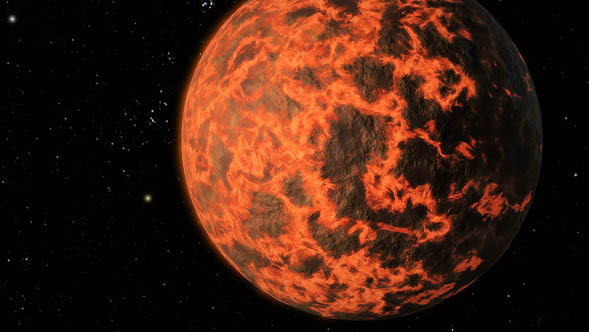
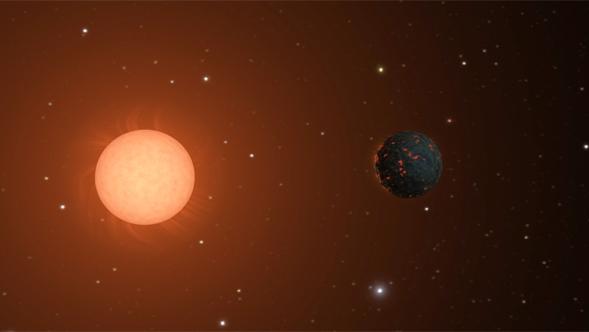
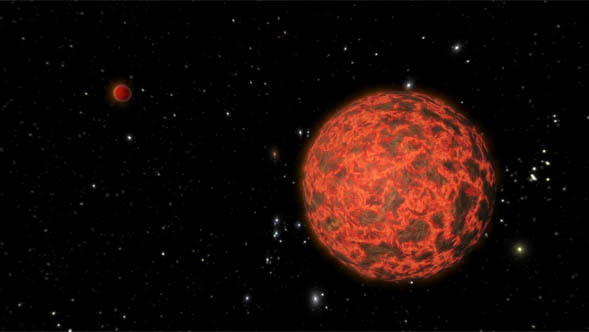
From here we move into the GJ 436 system, at first seeing the candidate planet UCF-1.01 as it transits its star. Although probably rocky in composition like Earth, UCF-1.01 would be a terrible place for life. The world orbits scorchingly close to its star, so in all likelihood this planet lacks an atmosphere and might even have a molten surface, as shown in this animation.
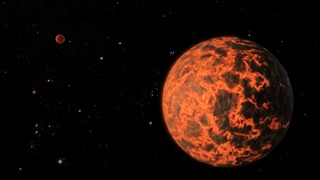
Near the end of the movie, a Neptune-sized exoplanet already known to exist around GJ 436, designated GJ 436b, appears in the background. Evidence for UCF-1.01 turned up when astronomers were studying this previously known world.
Browse Videos in Science Animations
07.18.12 Flying Out to GJ 436 and its PlanetsStarting from Earth, we quickly zoom out of the solar system into our sun's local neighborhood, populated by the clos... |
05.08.12 Super Earth Reveals Itself to Spitzer (Narrated)NASA's Spitzer Space Telescope has, for the first time, captured the light emanating from a distant super Earth, a pl... |
05.08.12 Super Earth Reveals Itself to SpitzerNASA's Spitzer Space Telescope has, for the first time, captured the light emanating from a distant super Earth, a pl... |
10.19.10 Weird Warm Spot on ExoplanetThis animation illustrates an unexpected warm spot on the surface of a gaseous exoplanet. NASA's Spitzer Space Telesc... |
10.19.10 Weird Warm Spot on Exoplanet (Narrated)This animation illustrates an unexpected warm spot on the surface of a gaseous exoplanet. NASA's Spitzer Space Telesc... |
|
10.06.09 Saturn Family TourThis video showcases the Saturnian system, beginning with the planet itself and panning out to its newest addition --... |
|
08.10.09 Planetary Demolition DerbyThis artist's animation shows a celestial body about the size of our moon slamming at great speed into a body the siz... |
06.04.09 Silicate Crystal Formation in the Disk of an Erupting StarThis artist's animation illustrates how silicate crystals like those found in comets can be created by an outburst fr... |
06.04.09 Tour of Planet with Extreme Temperature SwingsThis animation shows a computer simulation of the planet HD 80606b from an observer located at a point in space lying... |
07.15.08 Zooming in on Second-Brightest Star in Milky WayThis movie zooms in to reveal the "Peony nebula" star -- the new second-brightest star in the Milky Way, discovered i... |
05.05.08 Dissecting a Light EchoThis animation illustrates how a light echo works, and how an optical illusion of material moving outward is created.... |
05.05.08 Cauldron of LightIn this animation, a seething cauldron of light appears to bubble and ooze around the remains of a giant star that as... |
11.29.07 Pulling Back the Curtain of DustThis artist's animation begins by showing a dark and dusty corner of space where little visible light can escape. The... |
05.09.07 Blacker than BlackThis artist's animation illustrates the hottest planet yet observed in the universe. The scorching ball of gas, a "ho... |
05.09.07 Mapping Exotic WorldsThis animation shows the first-ever map of the surface of an exoplanet, or a planet beyond our solar system. The map,... |
05.09.07 How to Map a Very Faraway PlanetScientists using NASA's Spitzer Space Telescope were able to create the first-ever map of the surface of a planet bey... |
04.18.07 Highway to the Danger Zone"The further on the edge, the hotter the intensity," sings Kenny Loggins in "Danger Zone," a song made famous by the ... |
04.18.07 Infrared RoseThis movie begins by showing an optical image of the Rosette nebula, a turbulent star-forming region located 5,000 li... |


Page
1
of
4