Super Earth Reveals Itself to Spitzer (Narrated)
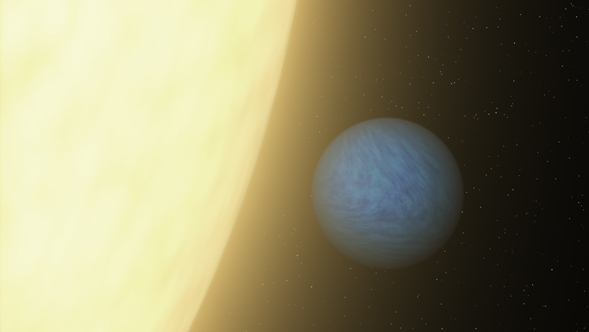
NASA's Spitzer Space Telescope has, for the first time, captured the light emanating from a distant super Earth, a planet more massive than Earth but lighter than Neptune. Super Earths can be either rocky or gaseous. In this case, theorists propose that the planet, called 55 Cancri e, has a rocky core surrounded by a layer of water in a "supercritical" state, where it is both liquid and gas. Topping it all off is thought to be a blanket of steam. It's as if Neptune were somehow dragged closer to the sun and stripped of its large atmosphere.
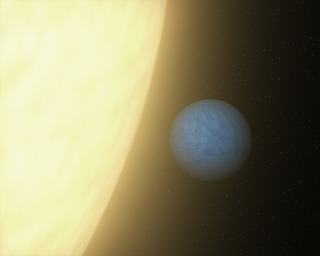
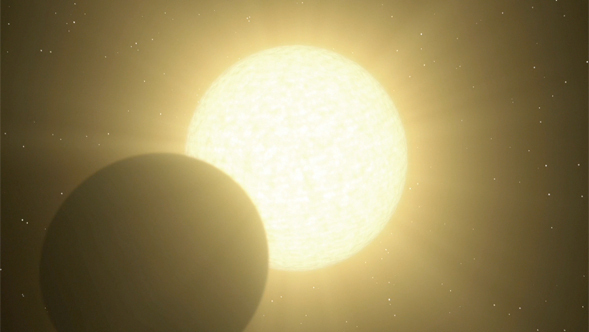
This artist's animation depicts 55 Cancri e as it orbits its star. The planet whips around the star closely and quickly: It is 25 times closer to the star than Mercury is to our sun and completes one orbit -- its year -- in a mere 18 hours.
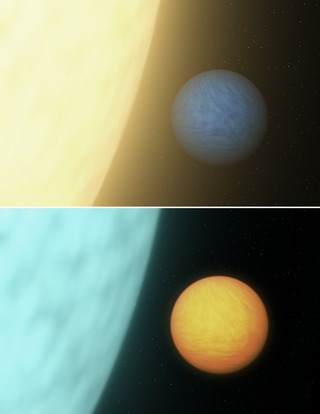
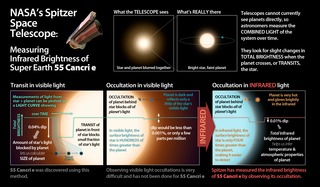
The view starts off showing the system in visible light then switches to show how Spitzer saw it in infrared light. In infrared, the planet stands out more relative to its star -- it is brighter when viewed in infrared light and the star is dimmer. This is partly because the planet 's sizzling heat causes it to glow brightly at infrared wavelengths.
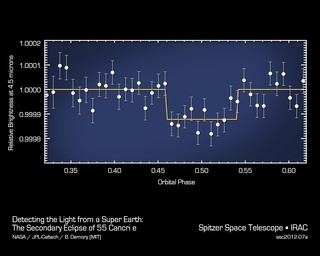
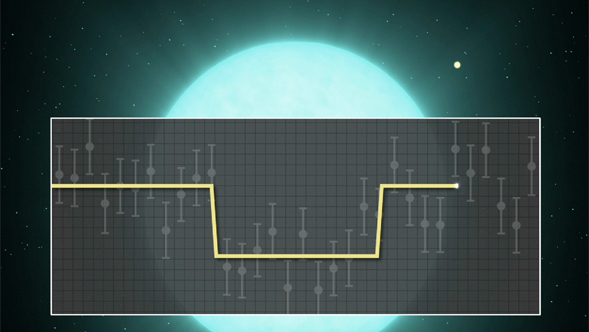
The planet is too close to its star to be seen separately on the sky, so Spitzer used a specialized trick to see its light. As the planet slipped behind the star in what is called an occultation, the infrared telescope observed how much the total light from the system dropped. The data are shown on a graph that appears in front of the star system.
By measuring the amount of total light before, during and after this drop, astronomers can then calculate how much light is coming directly from the planet itself. The information revealed that the planet's sun-facing side is more than a scorching 2,000 kelvins (3,140 degrees Fahrenheit), or hot enough to melt steel. The data also indicated that the planet does not reflect much visible light; in other words, it is very dark.
The observations are an important milestone in the search for life in the universe. NASA's upcoming James Webb Space Telescope will use a similar technique to probe the atmospheres of even smaller, potentially habitable planets for signs of life.
Browse Videos in Science Animations
07.18.12 Flying Out to GJ 436 and its PlanetsStarting from Earth, we quickly zoom out of the solar system into our sun's local neighborhood, populated by the clos... |
05.08.12 Super Earth Reveals Itself to Spitzer (Narrated)NASA's Spitzer Space Telescope has, for the first time, captured the light emanating from a distant super Earth, a pl... |
05.08.12 Super Earth Reveals Itself to SpitzerNASA's Spitzer Space Telescope has, for the first time, captured the light emanating from a distant super Earth, a pl... |
10.19.10 Weird Warm Spot on ExoplanetThis animation illustrates an unexpected warm spot on the surface of a gaseous exoplanet. NASA's Spitzer Space Telesc... |
10.19.10 Weird Warm Spot on Exoplanet (Narrated)This animation illustrates an unexpected warm spot on the surface of a gaseous exoplanet. NASA's Spitzer Space Telesc... |
|
10.06.09 Saturn Family TourThis video showcases the Saturnian system, beginning with the planet itself and panning out to its newest addition --... |
|
08.10.09 Planetary Demolition DerbyThis artist's animation shows a celestial body about the size of our moon slamming at great speed into a body the siz... |
06.04.09 Silicate Crystal Formation in the Disk of an Erupting StarThis artist's animation illustrates how silicate crystals like those found in comets can be created by an outburst fr... |
06.04.09 Tour of Planet with Extreme Temperature SwingsThis animation shows a computer simulation of the planet HD 80606b from an observer located at a point in space lying... |
07.15.08 Zooming in on Second-Brightest Star in Milky WayThis movie zooms in to reveal the "Peony nebula" star -- the new second-brightest star in the Milky Way, discovered i... |
05.05.08 Dissecting a Light EchoThis animation illustrates how a light echo works, and how an optical illusion of material moving outward is created.... |
05.05.08 Cauldron of LightIn this animation, a seething cauldron of light appears to bubble and ooze around the remains of a giant star that as... |
11.29.07 Pulling Back the Curtain of DustThis artist's animation begins by showing a dark and dusty corner of space where little visible light can escape. The... |
05.09.07 Blacker than BlackThis artist's animation illustrates the hottest planet yet observed in the universe. The scorching ball of gas, a "ho... |
05.09.07 Mapping Exotic WorldsThis animation shows the first-ever map of the surface of an exoplanet, or a planet beyond our solar system. The map,... |
05.09.07 How to Map a Very Faraway PlanetScientists using NASA's Spitzer Space Telescope were able to create the first-ever map of the surface of a planet bey... |
04.18.07 Highway to the Danger Zone"The further on the edge, the hotter the intensity," sings Kenny Loggins in "Danger Zone," a song made famous by the ... |
04.18.07 Infrared RoseThis movie begins by showing an optical image of the Rosette nebula, a turbulent star-forming region located 5,000 li... |


Page
1
of
4