Credit: NASA/JPL-Caltech/K. Gordon (University of Arizona)
Observation • November 24th, 2003 • ssc2003-06e
ssc2003-06e
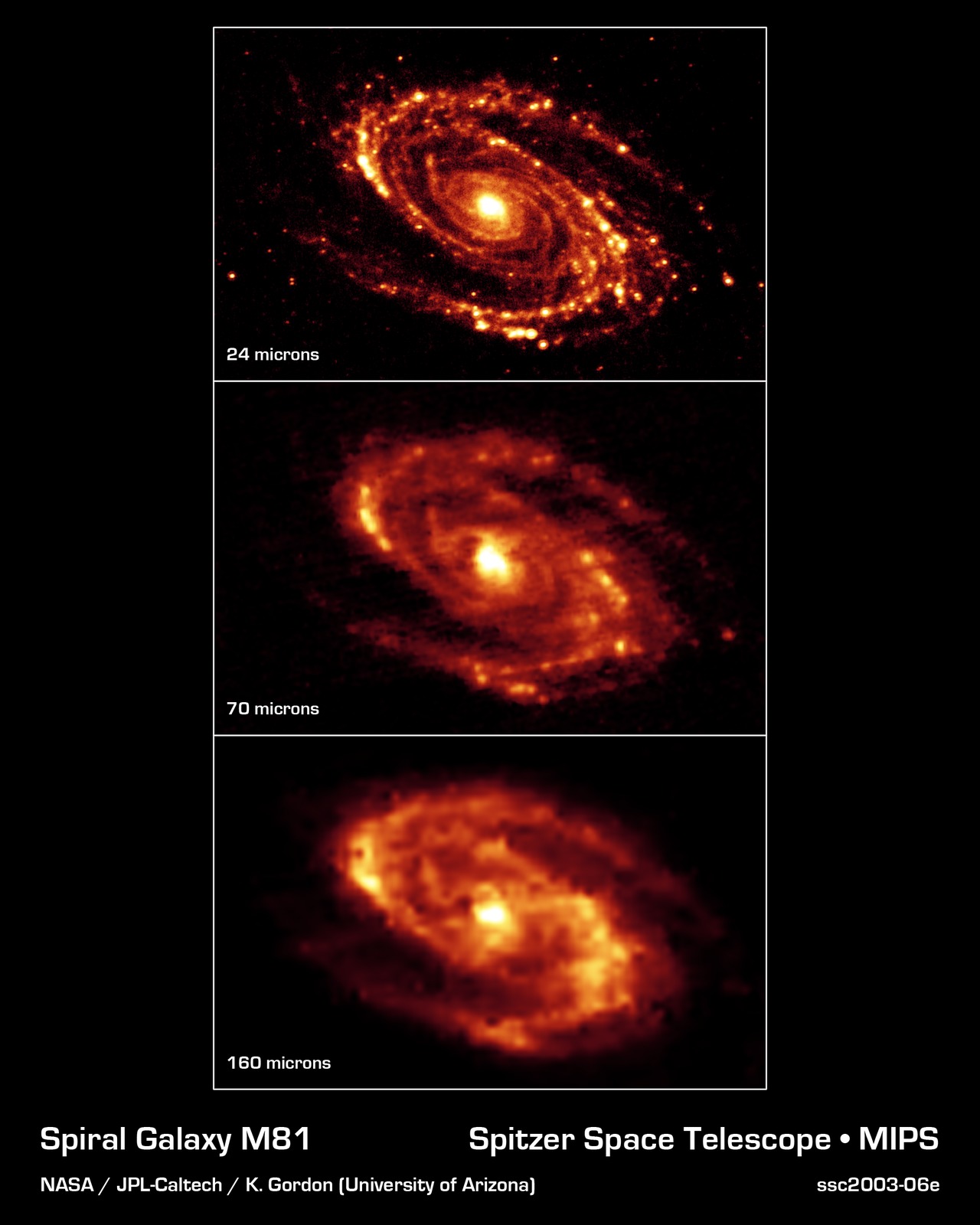
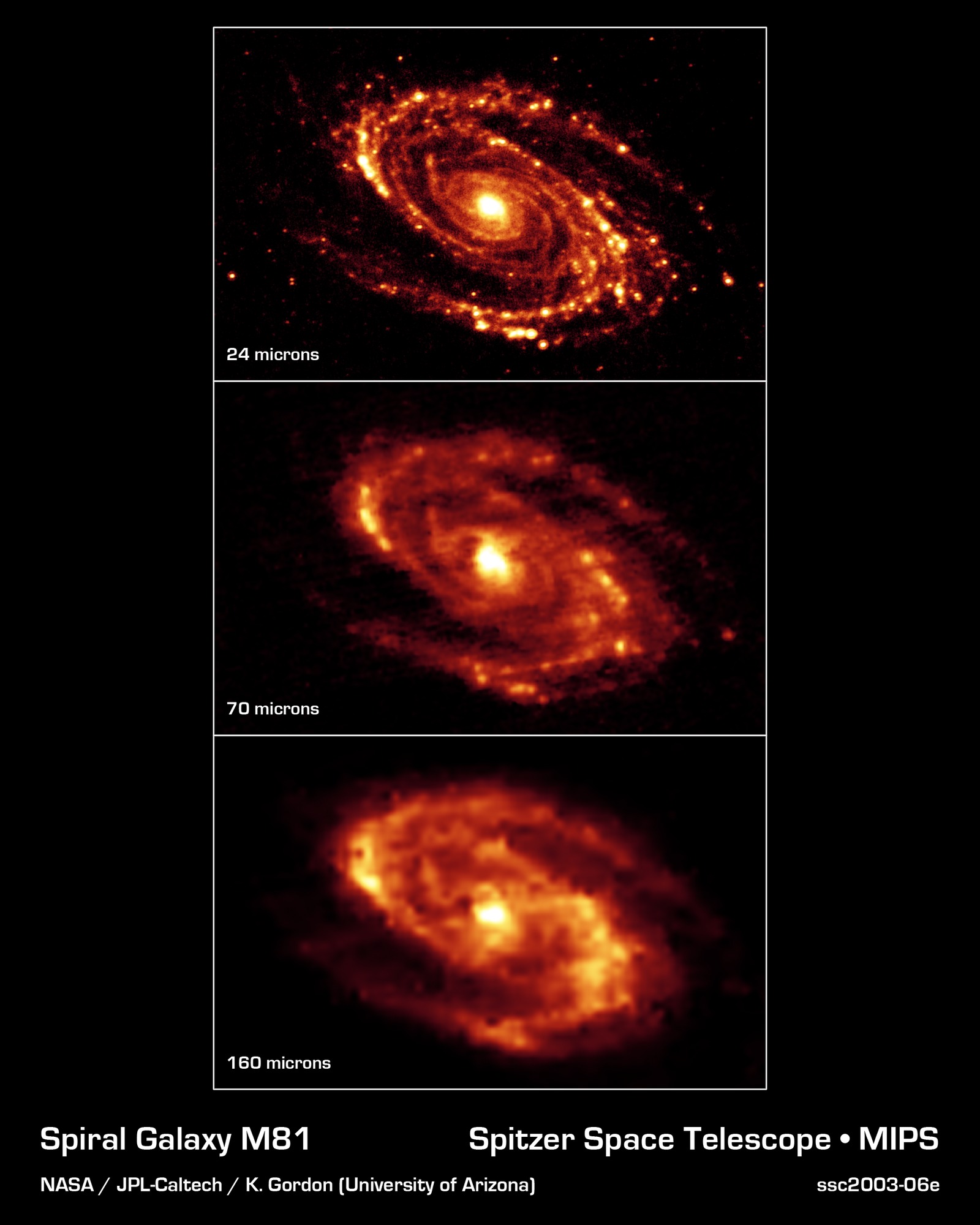
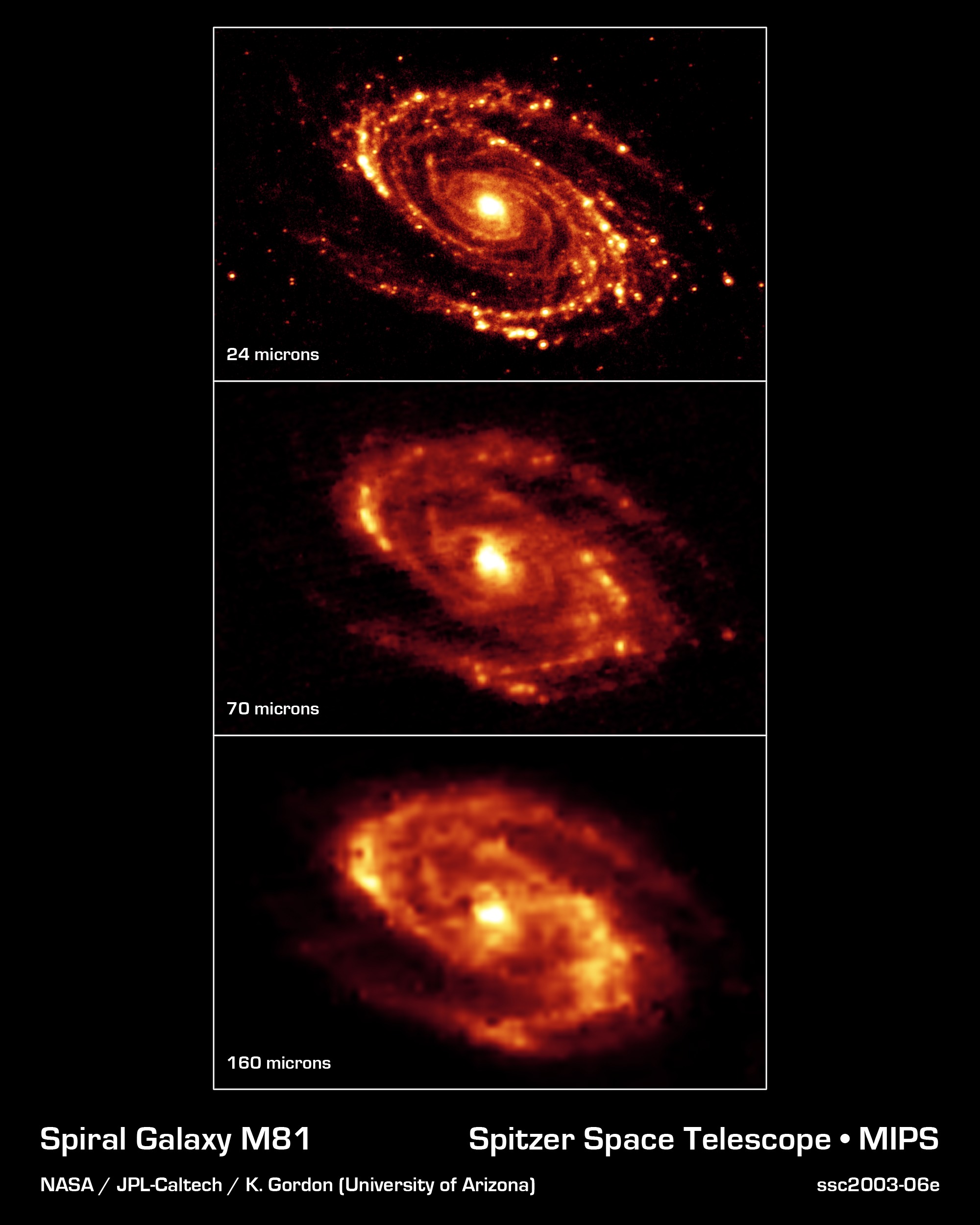
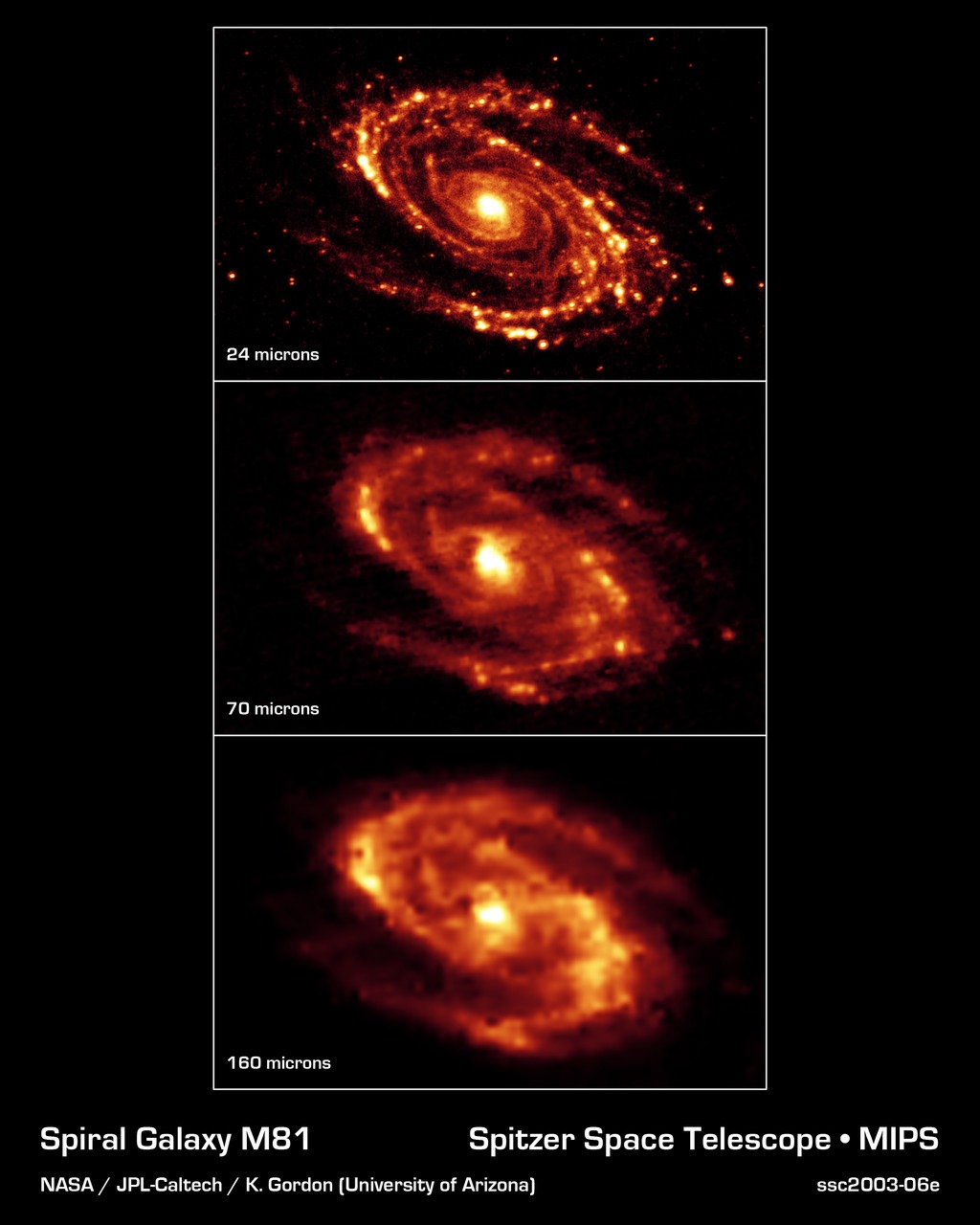
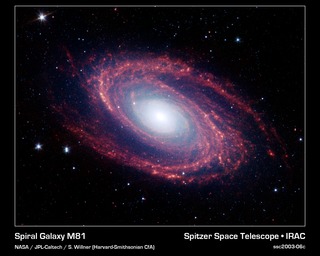
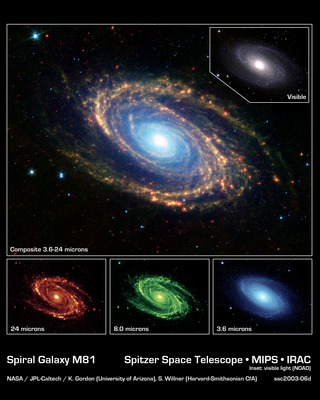
The magnificent and dusty spiral arms of the nearby galaxy Messier 81 are highlighted in these NASA Spitzer Space Telescope images. Located in the northern constellation of Ursa Major (which also includes the Big Dipper), this galaxy is easily visible through binoculars or a small telescope. M81 is located at a distance of 12 million light-years.
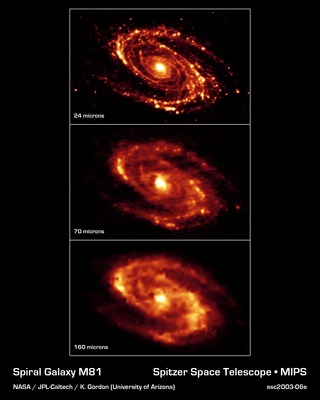
The three-panel mosaic is a series of images obtained with the multiband imaging photometer. Thermal infrared emission at 24 microns (top), 70 microns (center) and 160 microns (bottom) is shown in the images. Note that the effective spatial resolution degrades as ones moves to longer wavelengths.
At these wavelengths, Spitzer sees the dust, rather than the stars, within the disc of silicates and carbonaceous grains. It is well-mixed with gas, which is best seen at radio wavelengths, to form the essential ingredients for future star formation.
- 320x400 (40.7 KB)
- 500x625 (64.2 KB)
- 1024x1280 (159 KB)
- 1280x1600 (215 KB)
- 1600x2000 (293 KB)
- 2000x2500 (401 KB)
About the Object
- Name
- Bode's Galaxy • Messier 81 • M81 • NGC 3031 • UGC 5318
- Type
- Galaxy > Type > Spiral
- Distance
- 12,000,000 Light Years
- Redshift
- -0.000113
Color Mapping
| Band | Wavelength | Telescope |
| Infrared | 24.0 µm | Spitzer MIPS |
| Infrared | 70.0 µm | Spitzer MIPS |
| Infrared | 160.0 µm | Spitzer MIPS |
Astrometrics
- Position (J2000)
- RA =9h 55m 34.0s
- Dec = 69° 3' 54.9"
- Field of View
- 23.5 x 17.9 arcminutes
- Orientation
- North is 268.7° left of vertical