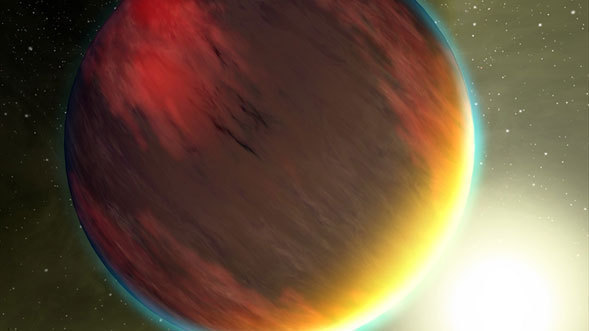
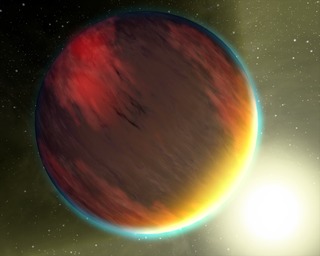
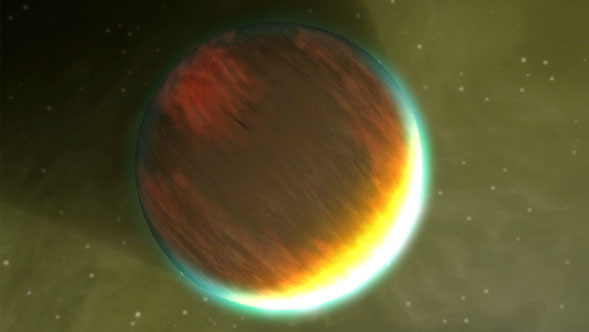
Hot, Dry, and Cloudy (Artist Concept)
Science Animations Video • February 21st, 2007 • ssc2007-04v1
This artist's concept animation shows a cloudy Jupiter-like planet that orbits very close to its fiery hot star. NASA's Spitzer Space Telescope was recently used to capture spectra, or molecular fingerprints, of two "hot Jupiter" worlds like the one depicted here. This is the first time a spectrum has ever been obtained for an exoplanet, or a planet beyond our solar system.
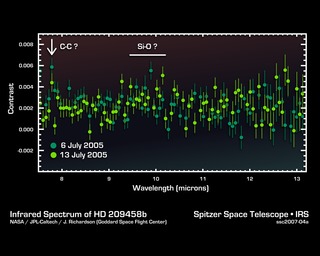
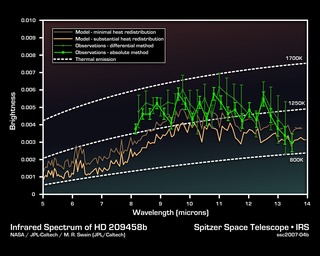
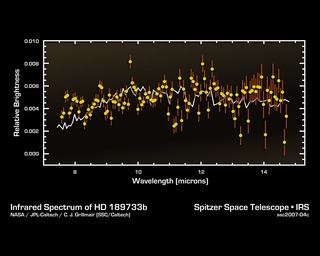
The ground-breaking observations were made with Spitzer's spectrograph, which pries apart infrared light into its basic wavelengths, revealing the "fingerprints" of molecules imprinted inside. Spitzer studied two planets, HD 209458b and HD 189733b, both of which were found, surprisingly, to have no water in the tops of their atmospheres. The results suggest that the hot planets are socked in with dry, high clouds, which are obscuring water that lies underneath. In addition, HD209458b showed hints of silicates, suggesting that the high clouds on that planet contain very fine sand-like particles.
Capturing the spectra from the two hot-Jupiter planets was no easy feat. The planets cannot be distinguished from their stars and instead appear to telescopes as single blurs of light. One way to get around this is through what is known as the secondary eclipse technique. In this method, changes in the total light from a so-called transiting planet system are measured as a planet is eclipsed by its star, vanishing from our Earthly point of view. The dip in observed light can then be attributed to the planet alone.
This technique, first used by Spitzer in 2005 to directly detect the light from an exoplanet, currently only works at infrared wavelengths, where the differences in brightness between the planet and star are less, and the planet's light is easier to pick out. For example, if the experiment had been done in visible light, the total light from the system would appear to be unchanged, even as the planet disappeared from view.
To capture spectra of the planets, Spitzer observed their secondary eclipses with its spectrograph. It took a spectrum of a star together with its planet, then, as the planet disappeared from view, a spectrum of just the star. By subtracting the spectrum of the star from the spectrum of the star and planet together, astronomers were able to determine the spectrum of the planet itself.
Neither of the parent stars for HD 209458b or HD 189733b can be seen with the naked eye. HD 209458b is located about 153 light-years away in the constellation Pegasus, while HD 189733b is about 62 light-years away in the constellation Vulpecula. Both planets zip around their stars in very tight orbits; HD 209458b circles once every 3.5 days, while HD 189733b orbits once every 2.2 days.
Of the approximately 200 known exoplanets, there are 12 besides HD 209458b and HD 189733b whose orbits are inclined in such a way that, from our point of view, they pass in front of their stars. At least three of these transiting exoplanets are bright enough to follow in the footsteps of HD 209458b and HD 189733 and reveal their infrared spectra to Spitzer. Astronomers hope to use Spitzer's spectrograph in the future to study HD 209458b and HD 189733b again in much greater detail, and to examine some of the other candidates for the first time.
Video Credit: NASA/JPL-Caltech/T. Pyle (SSC)