Icy Organics in Planet-Forming Disks
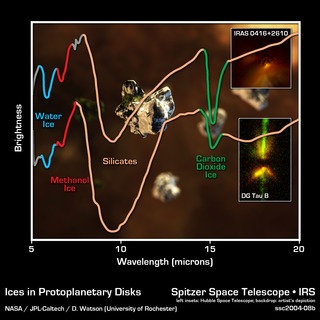
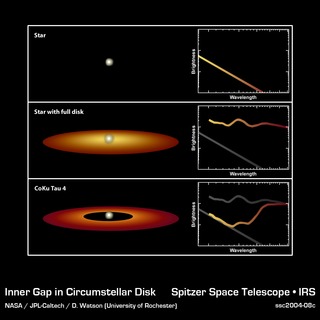
Using the Spitzer Space Telescope, astronomers are probing the chemistry of circumstellar disks, the dusty disks that surround stars, to understand the first moments in planetary life. Spitzer has turned its ultra-sensitive infrared spectrograph instrument toward five young stars in the constellation Taurus. These stars are still surrounded by thick, dusty disks -- relics of the gravitational collapse that formed them only a few million years ago. The five disks have similar chemistry, indicating dusty material rich in silicates and organic compounds, as well as both water and carbon dioxide ices. Despite their similarities, there are also intriguing differences between the disks that may hold important clues about the evolution of stars and their young planetary systems.
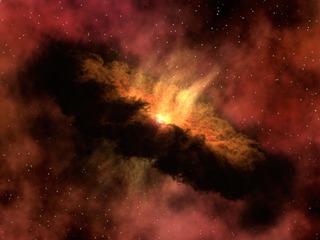
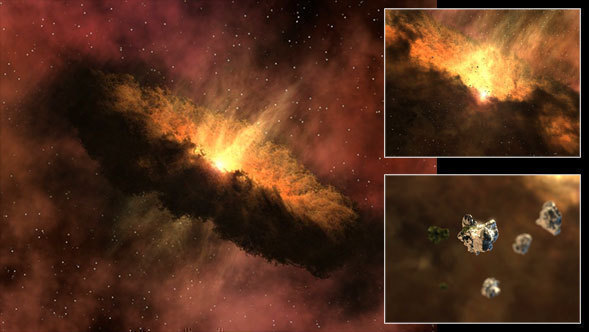
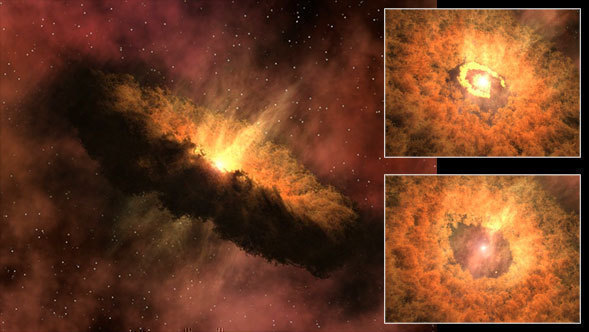
In this animation, we focus on the disk of a young star. Light from the star is almost completely blocked by the thick dust and is seen only when it scatters off dust and gas above the disk plane. Delving in closer, we observe that the disk is composed of countless tiny grains of dust, some of which, according to Spitzer observations, have crystal structures. These dust grains may serve as the first building blocks of new planets, accreting into larger and larger bodies, as time progresses.
As a few of these crystals fill our view, a strange metamorphosis takes place. Ice, already known to be present in these disks, begins to condense onto the surface of the crystals. Over time, the grains become larger, icier and more spherical. These chemical and physical changes in the dust grains may explain the differing spectral characteristics of the disks, and may also serve as a marker of the age and evolutionary stage of protoplanetary, or planet-forming, disks.
Browse Videos in Science Animations
03.29.07 Two Suns Raise Family of Planetary BodiesThis artist's animation depicts a faraway solar system like our own -- except for one big difference. Planets and ast... |
02.21.07 Hot, Dry, and Cloudy (Artist Concept)This artist's concept animation shows a cloudy Jupiter-like planet that orbits very close to its fiery hot star. NASA... |
12.18.06 Stars Spring Up Out of the DarknessThis artist's animation illustrates the universe's early years, from its explosive formation to its dark ages to its ... |
11.07.06 Hubble-Spitzer OrionThis video cycles between the Hubble view, the Spitzer view, and the combined Hubble-Spitzer view of the Orion Nebula. |
11.07.06 Making a Great Observatories CompositeThis video shows how a Hubble image and a Spitzer image of the Orion Nebula were combined to create a new, multi-wave... |
10.30.06 Who Ya Gonna Call?NASA's Spitzer Space Telescope is a galactic ghost buster, spotting hidden massive stars and other monsters lurking i... |
10.26.06 Order Amidst Chaos of Star's ExplosionThis artist's animation shows the explosion of a massive star, the remains of which are named Cassiopeia A. NASA's Sp... |
10.12.06 Fire and Ice Planet (without data plot)This artist's animation shows a blistering world revolving around its nearby "sun." NASA's infrared Spitzer Space Tel... |
10.12.06 Fire and Ice PlanetThis artist's animation shows a blistering world revolving around its nearby "sun." NASA's infrared Spitzer Space Tel... |
08.14.06 Journey to OrionThis movie begins with a visible view of the famous Orion constellation. Superimposed on the area near Orion's sword ... |
07.24.06 Stars Can't Spin Out of ControlThis artist's animation demonstrates how a dusty planet-forming disk can slow down a whirling young star, essentially... |
06.05.06 Fade to RedThis animation shows the Andromeda galaxy, first as seen in visible light by the National Optical Astronomy Observato... |
04.05.06 Birth of 'Phoenix' Planets?This artist's animation depicts the explosive death of a massive star, followed by the creation of a disk made up of ... |
03.16.06 Cigar Galaxy up in SmokeThis movie compares a visible-light view of the "Cigar galaxy" to an infrared view from NASA's Spitzer Space Telescop... |
06.09.05 The Cry of Cassiopeia AThis animation begins with a stunning false-color picture of the supernova remnant Cassiopeia A. It is made up of ima... |
06.02.05 Space Eyes See Comet Tempel 1This artist's concept of Tempel 1 illustrates the comet's shape, reflectivity, rotation rate and surface temperature,... |
05.30.05 Pillars Behind the DustThe movie begins with a visible-light picture of the southern region of our Milky Way galaxy then slowly zooms into t... |
05.30.05 Carina in ContextThis animation starts with an image of a larger but lower resolution image of the Carina Nebula from the Midcourse Sp... |
05.04.05 A More Spectacular SombreroThis movie shifts from the well-known visible-light picture of Messier 104 taken by the Hubble Space Telescope to inf... |
04.20.05 Band of RubbleThis artist's animation illustrates a massive asteroid belt in orbit around a star the same age and size as our Sun. ... |