Tour of Planet with Extreme Temperature Swings
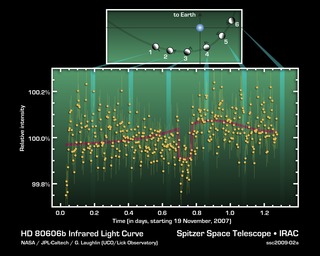
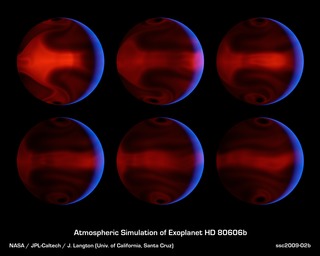
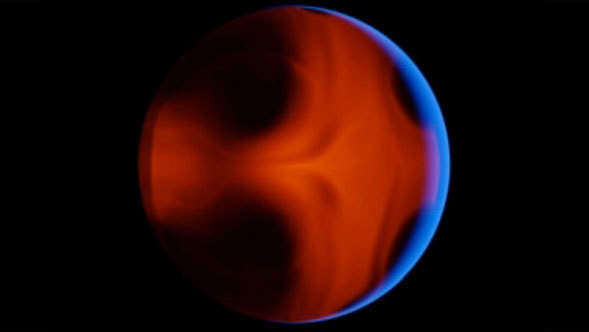
This animation shows a computer simulation of the planet HD 80606b from an observer located at a point in space lying between the Earth and the HD 80606 system. The animation starts 2.2 days before the moment of close approach and ends 8.9 days later. The blue areas are reflected starlight (the blue color arises mainly from absorption by sodium and potassium in the planetary atmosphere). Red regions are areas of the planet that are glowing with their own intrinsic heat.
The point of closest approach -- and maximum heating -- occurs about 4.5 seconds into the animation. As the planet whips around the star, we see the evolving thermal storm patterns across its unilluminated side. The planet's transit behind its star (as would be seen from Earth four seconds into the animation) is not shown in this simulation.
These theoretical models allow astronomers to better understand weather patterns on distant planets. While direct telescopic observations of the atmospheres of such worlds may be many decades away, such simulations give us a clue to what we may see when it becomes possible.
Browse Videos in Science Animations
04.20.05 Sunset on an Alien WorldThis artist's animation illustrates what the night sky might look like from a hypothetical alien planet in a star sys... |
03.22.05 Distant Planet Flaunts its LightThis artist's animation shows a close-up view of a distant giant planet passing behind its star as a regular part of ... |
03.22.05 How to Measure a Planetary EclipseThis artist's animation shows a close-up view of a distant giant planet passing behind its star as a regular part of ... |
03.22.05 A Planet in a Different LightThis artist's animation shows first what a fiery hot star and its close-knit planetary companion might look like clos... |
03.01.05 Invisible Galaxies Come to LifeThis artist's animation demonstrates that an invisible galaxy shrouded in dust can become glaringly bright when viewe... |
02.11.05 Spitzer's Delicate Ring FlowerNASA's Spitzer Space Telescope finds a delicate flower in the Ring Nebula, as shown in this animation. The outer shel... |
02.07.05 Birth of an Unusual Planetary SystemThis artist's animation shows a brown dwarf surrounded by a swirling disk of planet-building dust. NASA's Spitzer Spa... |
01.12.05 Trifid's Shifting SidesThis movie shifts from the well-known visible-light picture of the glowing Trifid Nebula to infrared views from NASA'... |
12.09.04 The Evolution of a Planet-Forming DiskThis animation shows the evolution of a planet-forming disk around a star. Initially, the young disk is bright and th... |
12.09.04 A Distant Solar SystemThis animation portrays an artist's concept of a distant hypothetical solar system, about the same age as our own. It... |
11.09.04 Icy Dawn of a Newborn StarIn this animation, we observe what a young star with a circumstellar disc would look like when viewed from different ... |
10.18.04 Swirling Rings of DustThis animation depicts colliding rocky bodies in an early planetary system. Such collisions form the basis of the pla... |
10.18.04 When Worlds CollideThis animation illustrates a massive collision between rocky, embryonic planets as big as mountain ranges. Such colli... |
10.12.04 Galactic Fossil Revealed in Infrared LightThis animation demonstrates the power of infrared light to see what visible light cannot -- a newfound bundle of star... |
10.07.04 Visible-Infrared WhirlpoolThis animation transitions from the more familiar visible light image of the "Whirlpool Galaxy" to the dramatic new v... |
10.06.04 Supernova ExplosionThis animation of a supernova explosion demonstrates what happens when a massive star explodes and creates a shell of... |
10.06.04 Kepler's Supernova Remnant - Zoom-InThis "zoom" starts in the Scorpius constellation and pushes through deeper and narrower telescopic fields to at last ... |
10.06.04 Kepler's Supernova Remnant - Composite ImageThe composite view of the supernova splits into its three components: blue-green for Chandra, yellow for Hubble, and ... |
08.09.04 Spitzer Discovers Hidden RingThis animation transitions from a visible light image of the planetary nebula called NGC 246 to Spitzer's new infrare... |
06.01.04 Missing Host Galaxies Found in Infrared - 2In a collaborative effort between NASA's three Great Observatories, astronomers have solved a cosmic mystery by ident... |