Flying Out to GJ 436 and its Planets
Astronomers using NASA's Spitzer Space Telescope have detected what they believe is an alien world just two-thirds the size of Earth - one of the smallest on record. The exoplanet candidate, known as UCF-1.01, orbits a star called GJ 436, which is located a mere 33 light-years away. UCF-1.01 might be the nearest world to our solar system that is smaller than our home planet.
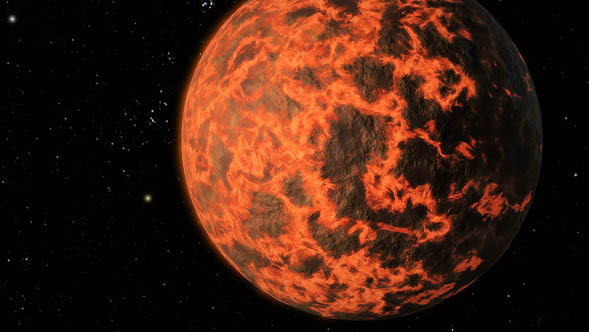
This artist's animation depicts a Star Trek-like voyage out to GJ 436, finished with a flyby of UCF-1.01.
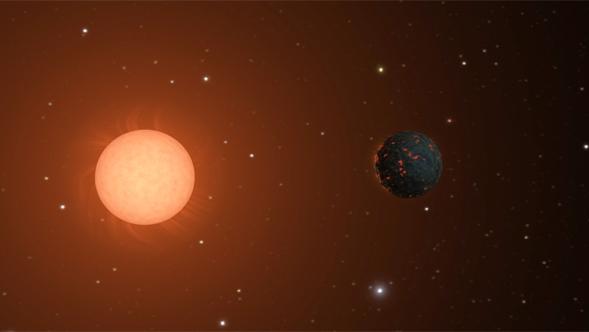
Starting from Earth, we quickly zoom out of the solar system into our sun's local neighborhood, populated by the closest stars that lie within a few light-years of Earth. Swinging around, we shift our attention to the dwarf star GJ 436, which is so faint that it is invisible to us until we get close enough to see its dim glow.
Because of GJ 436's proximity to our solar system, the star field around it shares many of our culture's famous cosmic landmarks. As we circle around the faint star, the constellation of Orion moves into view on the right, though in a distorted shape compared to our vantage point on Earth.
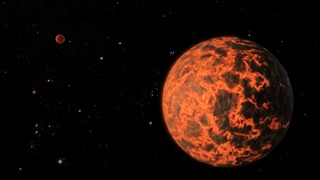
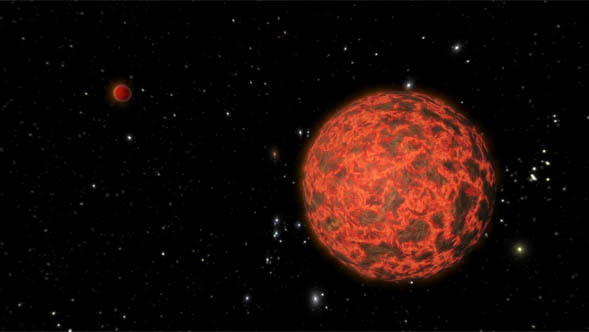
From here we move into the GJ 436 system, at first seeing the candidate planet UCF-1.01 as it transits its star. Although probably rocky in composition like Earth, UCF-1.01 would be a terrible place for life. The world orbits scorchingly close to its star, so in all likelihood this planet lacks an atmosphere and might even have a molten surface, as shown in this animation.
Near the end of the movie, a Neptune-sized exoplanet already known to exist around GJ 436, designated GJ 436b, appears in the background. Evidence for UCF-1.01 turned up when astronomers were studying this previously known world.
Browse Videos in Science Animations
06.01.04 Missing Host Galaxies Found in Infrared - 1In a collaborative effort between NASA's three Great Observatories, astronomers have solved a cosmic mystery by ident... |
06.01.04 The Making of a Galactic ParallelogramIn this animation, the elliptical galaxy Centaurus A is seen through the eyes of three different telescopes. Initiall... |
05.27.04 Spitzer Sheds Infrared Light on Hundreds of Newborn StarsObservations from NASA's Spitzer Space Telescope reveal hundreds of newly forming stars in the nebula RCW49, located ... |
05.27.04 Icy Organics in Planet-Forming DisksUsing the Spitzer Space Telescope, astronomers are probing the chemistry of circumstellar disks, the dusty discs that... |
05.27.04 Forming a Planetary GapAstronomers are using NASA's Spitzer Space Telescope to probe the structures of circumstellar disks, the dusty disks ... |
04.14.04 Star Formation in the DR21 RegionObservations from NASA's Spitzer Space Telescope reveal a turbulent nest of giant newborn stars too shrouded in dust ... |
03.15.04 Orbit of SednaThis animation shows the location of the newly discovered planet-like object, dubbed "Sedna," in relation to the rest... |
03.08.04 Star Formation in Henize 206Starting with a wide view of the environment surrounding the Henize 206 star formation region, the animation moves in... |
03.08.04 Triggered Star FormationThis animation illustrates the process of triggered star formation. First, a massive star in its final death throes e... |
01.13.04 The Tarantula NebulaNASA's new Spitzer Space Telescope has captured in stunning detail the spidery filaments and newborn stars of the Tar... |
12.18.03 Messier 81This 22-second animation uses an "infrared spotlight" to highlight differences between a visible-light image of Messi... |
12.18.03 Herbig-Haro 46/47This 18-second animation zooms in on Herbig-Haro 46/47 and its embedded protostar with molecular outflows. Spitzer/IR... |
12.18.03 Dark Globule in IC 1396This 22-second animation shows how our view of a dark globule in IC 1396 changes as we move from visible light throug... |
03.18.03 Model Dust RingA 12-second animation shows how ansae are created, by taking a model dust ring and tilting it from a face-on orientat... |